



Laser Eye Surgery Cost: What You Need to Know Before Your Eye Correction Procedure
Cost is a critical factor to consider when undergoing any procedure. It is crucial that you understand where your spending is going as well as the reliability of the procedure in order to make an informed decision. That’s why, when people visit the Excel Laser Vision Institute, one of their first questions is always, “How much is laser eye surgery?”

The cost of laser eye surgery can vary depending on the patient, clinic, and method. Whether you have a more complicated prescription or need a high-tech procedure, this can affect the overall price tag of your vision correction. However, almost every LASIK patient agrees that getting the surgery is more cost-effective and convenient than relying on contacts or glasses for the rest of their life.
To help determine if refractive surgery is in your best interest, let’s identify what contributes to the cost of Lasik operations and discuss the various financing options available today. Read on to find out why Lasik procedures are a valuable investment and why so many people choose to have them done.
Breakdown of Laser Eye Surgery Procedure Cost
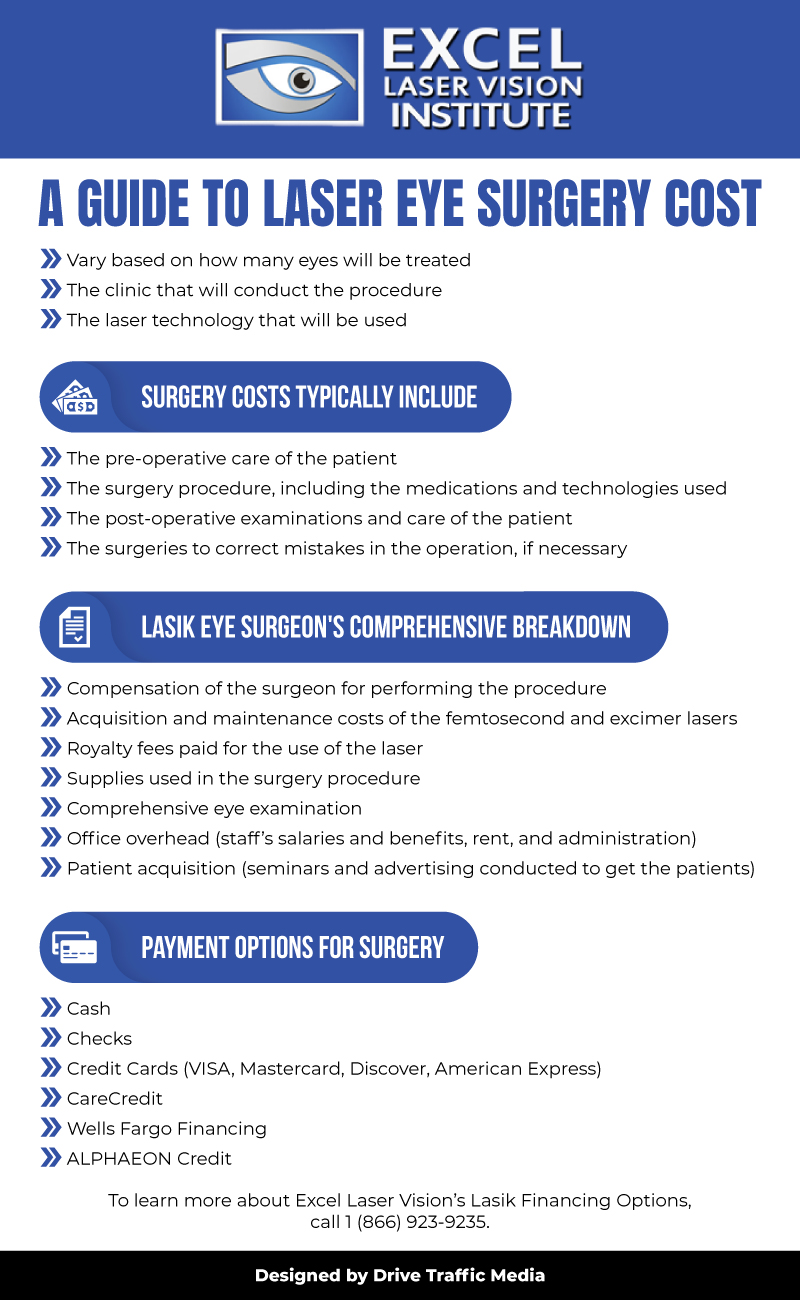
Laser eye surgery costs typically vary based on whether one or both eyes will be treated and what kind of clinic will conduct the procedure. Obviously, if you are only getting one eye done, this will be half the price of the average cost. Also, the rates of different clinics and surgeons will differ depending on their level of expertise. In addition, the laser technology that will be used — “bladeless” All-Laser-Lasik or “custom cornea” Wavefront-guided Lasik— also has a significant impact on the final rate. In this case, cheaper is not better.
If you are going for a “cheap” LASIK clinic, then you will likely get “cheap” results. This is why it is important to think of laser eye surgery as a long-term investment. You may have to pay more upfront, but this will reduce your risk of complications and ensure a lifetime of benefits. So, when you are vetting LASIK clinics, make sure that you check out their reviews, testimonials, and statistics. The best clinics will be transparent about their success rates and will explain anything that you are confused about in terms of cost. These are the things that LASIK surgery typically includes in its price tag:
- The pre-operative care of the patient
- The surgery procedure, including the medications and technologies used
- The post-operative examinations and care of the patient
Laser eye surgeons also provide comprehensive breakdowns of their operations during billing. They typically reveal these costs:
- Compensation of the surgeon for performing the procedure
- Acquisition and maintenance costs of the femtosecond and excimer lasers
- Royalty fees paid for the use of the laser
- Supplies used in the surgery procedure
- Comprehensive eye examination
- Office overhead, which includes the staff’s salaries and benefits, rent, and administration
- Patient acquisition, which includes the seminars and advertising conducted to get the patients
While this breakdown reveals a broader picture of what a laser eye surgery in Los Angeles involves, it is only a general outline. Get a more in-depth take of your operation costs from your Lasik clinic. You can also ask if there are any cost differences between the refractive surgeries they offer. For example, SMILE, PRK, and bladeless LASIK are all different forms of traditional laser eye surgery that they might offer. If you qualify for more than one procedure, then you may add cost comparison to the conversation with the recommendations of your surgeon.
Eyeing Payment Options for Surgery
Most people choose their eye surgeon based on who falls under their budget. However, we strongly advise that you get the most trusted and highly recommended surgeon available for the best Lasik experience. While you may be paying more in the initial cost, you will save money over the long run by not having to get the procedure done a second time in the case that an inexperienced surgeon makes a mistake.
At the Excel Laser Vision Institute, we have Harvard-trained Dr. Moosa at the front and center of our clinic. He has completed thousands of surgeries and has an extremely high patient satisfaction rate. Dr. Moosa is highly regarded in his field for his dedication to excellence. The best surgeons will use the best machines, which is how you know your procedure is the most advanced it can be.
High-quality eye surgery can be costly that is why most eye clinics offer patient-friendly financing alternatives. Here at Excel Laser Vision Institute, we offer these payment options:
- Cash – This is the easiest way of financing an operation.
- Checks – These are the more convenient payment option compared to cash as they are less risky and cumbersome to carry.
- Credit Cards – These are recommended for financing operations because of their installment options. We accept payments made with VISA, Mastercard, and American Express.
- Care Credit – This is a special credit card designed specifically for health and wellness transactions. It covers out-of-pocket expenses which aren’t included in medical insurance.
- Wells Fargo Health Advantage – This is a special credit card program that allows you to finance health care bills through special drawn-up plans. You get a revolving line of credit that can be used at any time.
Depending on your personal situation, you may also qualify for some insurance relief through FSA or HSA accounts. As long as you qualified for laser eye surgery, our staff will do our utmost to help you afford the procedure. Payment plans with loan options are commonly chosen by many patients in order to split the cost over time.
Finance Your Eye Surgery without Breaking Your Budget
Don’t let cost faze you when you ask, “how much is laser eye surgery?” Here at the Excel Laser Vision Institute, we ensure that you get the best deal for your operation. Our decades of experience have made us one of the most trusted names in the community. Schedule an appointment with us now at 866-923-9235 and get affordable and reliable laser eye surgery in Orange County and Los Angeles!

Important Details to Know Before Deciding to Get Laser Eye Surgery
Our bodies become more susceptible to wear and tear as we get older – our joints become frailer, memory isn’t as sharp, and vision becomes blurry. For these issues, there are various solutions to focus on them. One of the more pioneering procedures to ever appear in the last few decades is laser eye surgery.

What is a Laser Eye Procedure?
Many people ask about laser eye surgery costs because it is a very sought-after procedure since it is quick, safe, and painless. During a LASIK procedure, the LASIK surgeon creates a flap of tissue over the cornea and peels it back to have access to the cornea. Afterward, the laser will beam right into the eye to reshape the cornea, which is how the vision improves.
The whole procedure doesn’t take more than a minute. Once it is completed, the patient is given eye drops to ensure that their eyes don’t go dry.
Typically, LASIK surgery patients recover within 24 to 48 hours. This all depends on a person’s healing capabilities, but you can have peace of mind that you won’t have to wait a long time until you can see the world clearly again.
Who Should Get LASIK Surgery?
People who are sick and tired of wearing eyeglasses or contact lenses may want to go through LASIK surgery. This is a type of refractive eye surgery.
For the most part, many people who get laser-assisted in situ keratomileusis (LASIK) eye surgery attain 20/20 vision or better, which is sufficient for most activities. However, most people will still require glasses for driving at night or reading as they age.
LASIK has an excellent performance record. If there are ever complications that result in a loss of vision, they are rare, and many people are happy with their results. Specific side effects, especially dry eyes and temporary visual disturbances (such as glare), are fairly common. However, these usually clear up after a couple of weeks or months, and a minority of people think of them as long-term issues.
A person’s results rely on their refractive error and other factors. Those with mild nearsightedness usually have the most success with refractive surgery. Individuals with a high level of nearsightedness, farsightedness, and astigmatism have less predictable results.
Keep on reading about what to think about as you decide whether this surgery is suitable for you.
What Happens During LASIK?
There are quite a few variations of laser refractive surgery. LASIK is the most sought-after and most commonly performed eye surgery. Most of the time, the term “LASIK” is used to indicate all types of laser eye surgery.
Normally, images are focused on the retina that’s in the back of the eye. When it comes to nearsightedness, farsightedness, or astigmatism, they finish up being focused either in front of or behind the retina, ending in blurred vision.
- Nearsightedness (myopia) is a condition that lets you see objects nearby clearly, but objects that are far away appear blurry. When your eyeball is a little bit longer than normal or when the cornea curves too sharply, light rays focus in front of the retina and blur distant vision. A person can see objects that are close more clearly, but not those that are far away.
- Farsightedness (hyperopia) is a condition that lets you see objects far away clearly, but nearby objects are blurry. When you have a shorter than average eyeball or a cornea that is too flat, light focuses behind the retina rather than on it. This blurs near vision and occasionally distant vision.
- Astigmatism results in overall blurry vision. When the cornea curves or flattens unevenly, the outcome is astigmatism, which interrupts the focus of near and distant vision.
Normally, blurry vision is corrected by bending (refracting) light rays with glasses or contact lenses. Nevertheless, reshaping the cornea (the dome-shaped transparent tissue at the front of your eye) itself can provide the necessary refraction and vision correction
Prior to a LASIK procedure, your LASIK eye surgeon will determine the detailed measurements of your eye and assess the eye’s overall health. Your eye surgeon may ask you to take a mild sedative medication just before the procedure.
Eye-numbing drops will be administered once you are lying comfortably on an operating table. Then he or she will use a unique type of cutting laser to alter the curvature of your cornea accurately.
Whenever the laser beam sends a pulse, a very small amount of corneal tissue is taken off, allowing your eye surgeon to flatten the curve of your cornea or make it steeper.
Typically, an eye surgeon creates a flap in the cornea and then lifts it before reshaping it. Also, there are variations that involve a thin flap to be raised or no flap is used at all. Nonetheless, each technique has its pros and cons.
What are the Kinds of Laser Eye Procedures?
Every LASIK eye surgeon may specialize in specific types of laser eye procedures. Their differences are usually small, and none are clearly better than any others. Depending on your individual situation and preferences, you may consider:
- 1. Laser-Assisted in Situ Keratomileusis (LASIK): It’s the most commonly performed eye laser surgery, LASIK involves making a partial-thickness corneal flap and utilizing an excimer laser to ablate the bed of the cornea. The flap is then put back into its original position. Discomfort after surgery is very little, and vision recovery usually takes place in 1 to 2 days.
- 2. Photorefractive Keratectomy (PRK): With PRK, instead of creating a flap, the top surface (epithelium) is scraped away. This corneal abrasion takes three or four days to heal, and the outcome is moderate pain and blurred vision in the short term.
It was considered that these disadvantages were canceled out by the theoretical advantage that PRK was safer for those who are more likely to be stuck in the eye — for instance, those involved in law enforcement, military, or contact sports. However, even with standard LASIK, the risk of eyeball rupture is still very low, so there is probably no significant advantage with PRK. Additionally, LASIK is a better option than PRK for correcting more severe nearsightedness (myopia).
3. Laser-Assisted Subepithelial Keratectomy (LASEK): LASEK is no different from LASIK surgery, but the flap is made by using a special cutting device (microkeratome) and exposing the cornea to ethanol. The procedure lets the surgeon remove less of the cornea, making it a good option for those who have thin corneas. LASEK does not have any considerable advantages over LASIK for individuals at greater risk of eye injuries.
4. Epithelial Laser-Assisted in Situ Keratomileusis (epi-LASIK): In an epi-LASIK procedure, your laser eye surgeon separates the epithelium from the middle part of the cornea called the stroma) using a mechanized blunt blade device known as an epikeratome and reshapes the cornea with a laser. This procedure is similar to LASEK.
5. Small-Incision Lenticule Extraction (SMILE): This is a more contemporary type of refractive surgery that allows the eye surgeon to reshape the cornea. To do this, the surgeon uses a laser to make a lens-shaped bit of tissue known as the lenticule which is located below the cornea surface. When the lenticule has been used to reshape the cornea, it is then removed through a very small incision.
6. Intraocular Lenses: A laser eye surgeon can use surgically inserted corrective lenses in the eye, which are also known as intraocular lenses) to enhance vision. It’s normally carried out as part of cataract surgery, which involves removing the old, cloudy natural lens. Additionally, it may be an alternative to LASIK for older adults who may require cataract surgery in the future.
Younger people with high levels of nearsightedness that cannot be properly treated with corrective lenses may be offered intraocular lenses. However, these are not a typical options for most people.
7. Bioptics: Bioptics uses one or more techniques, such as intraocular lenses and LASIK, to treat nearsightedness or farsightedness.
If you want to discover more about LASIK procedures, contact Excel Laser Vision Institute at (310) 905-8622. A member from our dedicated team will be happy to answer all your questions about the type of refractive surgery that is best suited for you!


3 Preparation Tips for Best Results when Getting Laser Eye Surgery
An increasing number of people in southern California who experience vision problems are now turning to Orange County LASIK surgery to finally get the clear vision that they have always dreamed of. Although the actual procedure only takes up to 15 minutes, that doesn’t exempt you from needing to prepare for it. Here are the best steps you can take to prepare yourself for your operation, straight from our team to our valued patients:

Be Realistic. Understand What LASIK Can and Cannot Achieve
Familiarizing yourself with the entire process, from pre-surgery to aftercare, will make you feel more confident walking into your appointment. This particular type of laser eye surgery is designated to alter the shape of your cornea so that you can see more clearly, but it is not right for every patient. For instance, if you have excessively dry eyes or have a more serious and permanent vision impairment, the doctor can deny performing the procedure on you. In order to evaluate your candidacy, you will undergo a comprehensive eye examination, and the doctor will decide which strategy will be best for you.
Select a Highly-Skilled and Experienced Specialist
Selecting a LASIK surgeon who has extensive experience in his profession will ensure you get the best results for your money and your eye health. You want to choose somebody who knows exactly what they are doing, and you will be able to fully trust.
Plan Well Ahead of Time
While you can opt for LASIK surgery as long as you are at least 18 years old and have been approved by an ophthalmologist, a stable prescription lasting for a minimum of 2 years is required prior to your operation. Ask as many questions as possible during your consultation appointment, write them down and bring them to the office if it helps you remember all of them. If any new questions arise in between appointments, contact your doctor right away. Never wait until the last minute to ask important questions about your procedure.
Inform your employer in advance of your LASIK surgery so you may get a couple of days off from work. If you are still in school, you may want to consider scheduling your operation during a break so that you will not have to miss any of your classes. You should be prepared to feel discomfort following surgery, such as slight itching, burning, or watering. This is why you must plan to have somebody you trust drop you off and pick you up from the surgery ahead of time since you will not be allowed to drive.
Are You Ready to Change Your Life with LASIK?
Are you interested in LASIK but uncertain where exactly to start? If so, please reach out to our Brea office today to schedule your free consultation appointment! Our doctor can answer any questions you have, whether it be regarding your candidacy or the cost of laser eye surgery.